quick answer
Sort out the coats you wear daily, then give each one a hook at the door or on the back of a door. Put wet boots on a lipped tray on the floor, and keep hats and gloves in one basket. Check the weight limit on every hook, and store off-season coats elsewhere.
Level: easy
You will need: over-the-door hook rack, removable adhesive hooks, waterproof boot tray, two-tier shoe rack, basket for hats and gloves, tape measure
Winter coat storage in a small apartment is hard because the gear is bulky, wet, and needed every day. One closet can’t hold three puffy coats, boots, scarves, and a dog leash. So the pile ends up on a chair, the couch, or the floor.
This guide gives you 8 ideas that mostly work without drilling. You will sort what really needs to be near the door, add hooks and trays that come off when you move, and set up a spot where wet things can dry. Pick two or three that fit your space and start there.
in this guide
- Pick the daily coats first, then store the rest
- Over-the-door hooks for the coats you wear daily
- Removable hooks at two heights
- A lipped boot tray that catches the mess
- Stack boots and shoes on a low two-tier shelf
- One basket for hats, gloves, and scarves
- A narrow rack or shelf, set up so it can’t tip
- Give wet coats a place to drip and dry
Pick the daily coats first, then store the rest
Most small closets are full because every coat gets equal space. Start by pulling out the coat each person wears most days. Add one backup, such as a rain jacket or a lighter layer.
Those coats get the best spot, which is the one closest to the door. Everything else goes deeper in the closet, in a bedroom, or on a high rod.
To do it, lay out all your coats on the bed. Group them into daily, sometimes, and rarely. Count the daily group, because that number tells you how many hooks or hanger spots you need by the door.
Over-the-door hooks for the coats you wear daily
An over-the-door rack uses space you already have. It hangs on the top edge of a door, so there is nothing to drill or stick. It works best on a closet or bedroom door.
Measure the thickness of your door and compare it to the gap on the hook. Then check the weight limit on the package. Winter coats are heavy, especially wet ones, so spread them out instead of piling three on one hook.
Put the heaviest coat on the hook nearest the hinge side, where the door swings least. Keep bags and scarves on the smaller hooks. Open and close the door a few times to make sure it still latches without bumping the rack.
Skip this on an entry door if it keeps the door from closing or latching fully.
Shop the idea: over-the-door hook rack on Amazon (for example, Command or mDesign)
Renter note: Over-door hooks can scuff paint or press on weatherstripping. Stick a thin felt pad where the hook touches the door, and check that the door closes fully.
snug tip
Before you load the rack, open and close the door a few times to check that it still latches and swings freely. Then add coats one at a time.
Removable hooks at two heights
Adhesive hooks give you a coat spot on any flat, smooth wall. Put one row at adult shoulder height for coats. Put a lower row for kids’ jackets, dog leashes, or a tote bag.
Pick hooks rated for more weight than your heaviest coat, and stay well under the limit. Clean the wall with a damp cloth and let it dry fully before you stick anything on. Then follow the package for how long to wait before hanging weight.
If your walls are textured, brick, or freshly painted, adhesive may not hold. Damp entryways can also weaken it over time. Test one hook with a light item first and watch it for a few days.
Shop the idea: removable adhesive hooks on Amazon (for example, Command)
Renter note: Adhesive hooks can pull off paint, so test a small spot first and follow the package steps for taking them off. Wait for fresh paint to cure, which can take weeks.
A lipped boot tray that catches the mess
Boots leave puddles, salt, and grit. A tray with a raised edge keeps that off your floor and gives boots one clear place to live. It also stops the slow creep of shoes across the whole entry.
Measure the floor space you can spare, then measure your largest pair of boots. The tray should fit them side by side with a little room around them. A tray that is too small just means boots hang over the edge.
Choose a material that wipes clean, such as rubber or plastic. When it fills with grit, take it to the sink or tub, rinse it, and dry it before putting it back.
If you have a pet, wipe up melted de-icer and salt promptly. It can irritate paws and upset a stomach if licked.
Shop the idea: waterproof boot tray on Amazon (for example, Gorilla Grip)
snug tip
Keep a small cloth or old towel next to the tray so you can wipe boot soles and the tray’s edge in a few seconds.
more checklists like this
Get new small-space checklists by email now and then. New subscribers also get our 90 printable pantry labels as a welcome gift.
Stack boots and shoes on a low two-tier shelf
If floor space is tight, go up instead of out. A low two-tier rack holds one pair of boots on the bottom and a few pairs of shoes on top. Boots with tall shafts need more height, so measure them first.

Set the rack against a wall, either beside the door or inside the closet. Keep only this season’s pairs on it. Move sandals and rarely used shoes to a bin elsewhere.
If you have a puppy, keep chewable items such as leather laces out of reach. Wet boots can also leave a puddle on the rack’s lower shelf, so set the tray under it or dry boots on the tray first.
Shop the idea: two-tier shoe rack on Amazon (for example, Simple Houseware or Songmics)
One basket for hats, gloves, and scarves
Small winter items disappear fast. A single basket or box by the door gives them a home so you are not hunting for a left glove on your way out.
Use a basket with a wide opening so you can drop things in while wearing coats. Put it on the floor under the hooks, on a shelf, or on top of the shoe rack. Give each person a smaller bin inside if you share the space.
Keep the basket to this winter only. If it overflows, pull out the extras and store them with your off-season things.
A narrow rack or shelf, set up so it can’t tip
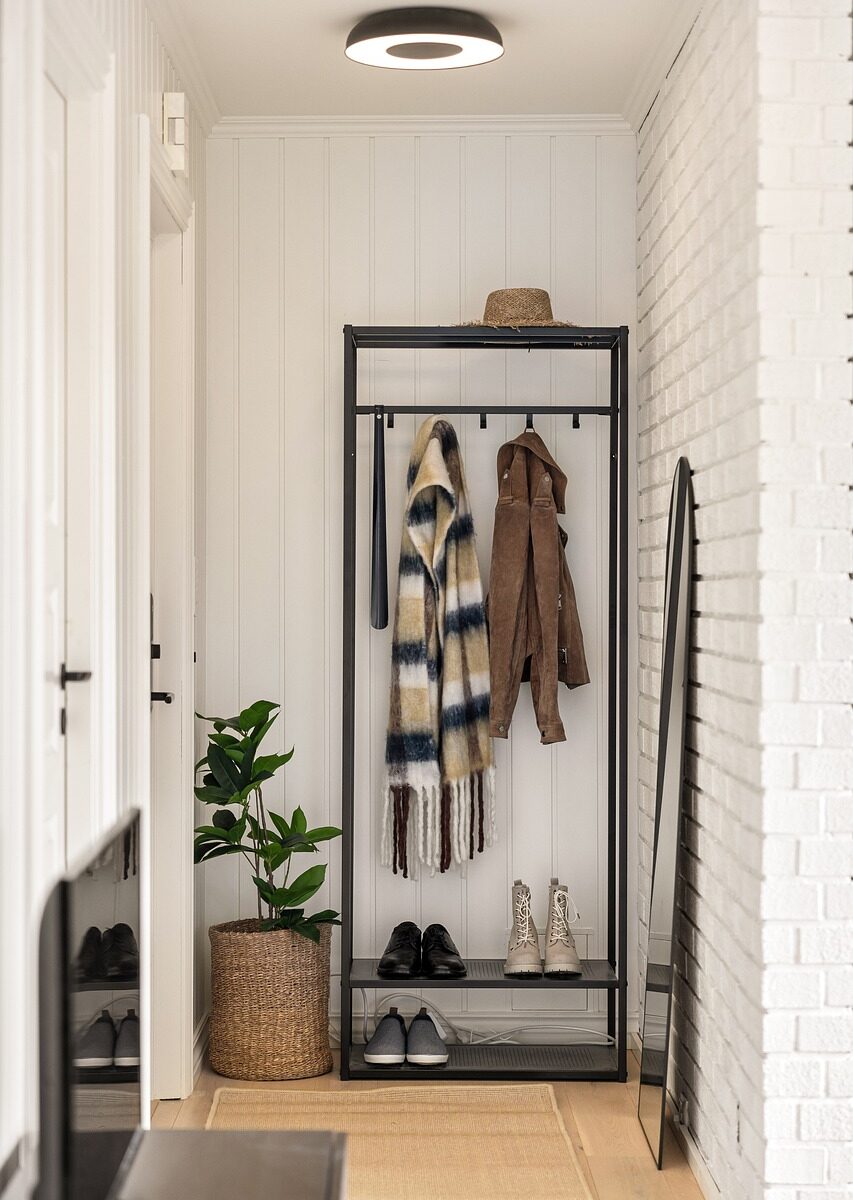
A slim freestanding coat rack or a tall, narrow shelf can work when you have no wall to use. But a rack loaded with heavy coats can get top-heavy and fall, and a tall shelf can tip if someone climbs it or pulls on it.
Choose one with a wide, heavy base. Hang the heaviest coats on the lower hooks and the lighter things higher up. Keep it in a corner, away from the swing of the door.
For a tall shelf, the CPSC recommends anchoring it to the wall. If you can’t anchor it, pick a shorter, lower unit instead, especially with kids or pets in the home.
Learn more: CPSC Anchor It: Prevent Furniture Tip-Overs
Renter note: Check your lease before drilling any anchor into a wall, and ask your landlord if you aren’t sure.
Give wet coats a place to drip and dry
A wet coat jammed into a packed closet can stay damp and start to smell. Give wet gear its own spot where air can move around it. A hook above your boot tray is a good choice, since drips land on the tray.
Hang wet coats with space between them, and shake off snow before you come in. Let them dry fully before moving them to the closet. A hook for a dog towel nearby also helps on muddy or snowy days.
If you have no room for a drying spot, hang the coat on a door in a room with some airflow. A steamy bathroom is a poor choice because the air is already humid. Keep coats off radiators and space heaters, which can damage the fabric and are a fire risk.
from our shop

Want labels for those bins and baskets? We made a printable set of 48 wide labels for the bathroom, closet and linen shelf, plus blanks to fill in.
Made by us · sold on Creative Fabrica · affiliate link
Where to start
This weekend, pull out every coat and sort them into daily, sometimes, and rarely. Move the “rarely” group out of the entry area, into a bedroom closet or under the bed.
Then measure your door thickness and the floor space by the door. Set up one hook row or over-the-door rack, add a boot tray, and put a basket under the coats for hats and gloves. You can add the rest later.
free printable checklist
Winter Coat and Boot Checklist
8 steps. Tick them off as you go (your ticks stay on this device), or print it and keep it where you do the job.
The Snug Nook · thesnugnook.com
Quick answers
How do you store winter coats in a small apartment with no closet?
Use the walls and doors. Over-the-door hooks and removable adhesive hooks hold coats without drilling. Add a boot tray on the floor and a basket for small items.
How many coats should you keep near the door?
Usually one daily coat per person, plus one backup, is enough. More than that and the hooks get crowded, and the coats you actually wear get buried. Store the rest in a closet or bedroom.
Can adhesive hooks hold heavy winter coats?
Some can, but only up to the weight listed on the package. Wet coats weigh more than dry ones, so choose a hook rated well above your heaviest coat. Follow the package steps for cleaning the wall and waiting before you hang anything.
join the snug nook list
New checklists in your inbox
Occasional small-space checklists and tips, plus 90 printable pantry labels as a welcome gift. Unsubscribe anytime.